
Catch your breath
Feeling stressed? Time to play
For this first exercise we will get friendly with our physical reaction to stress without trying to change it. You guessed it, not changing it while examining it is the hard part. The next time you are stressed (and maybe not in the middle of a meeting) document your stress.
- Set up: Grab a piece of paper and a comfortable drawing tool like a pencil, marker, or pen.
- Observe: Close your eyes or soften your gaze (after you read the whole exercise), position your pen on the left side of your page, and notice how you breathe. We are not looking so we can focus on the sensation, not the output.
- Sync the line: Move your hand upward as you inhale, and move downward as you exhale, one line, towards the right. Let the length of the lines match the speed of your breath. For a short inhale a short line upward, for a long exhale a longer one downward.
- Release the outcome: Focus entirely on the physical sensation and the present moment rather than making a „good” picture.
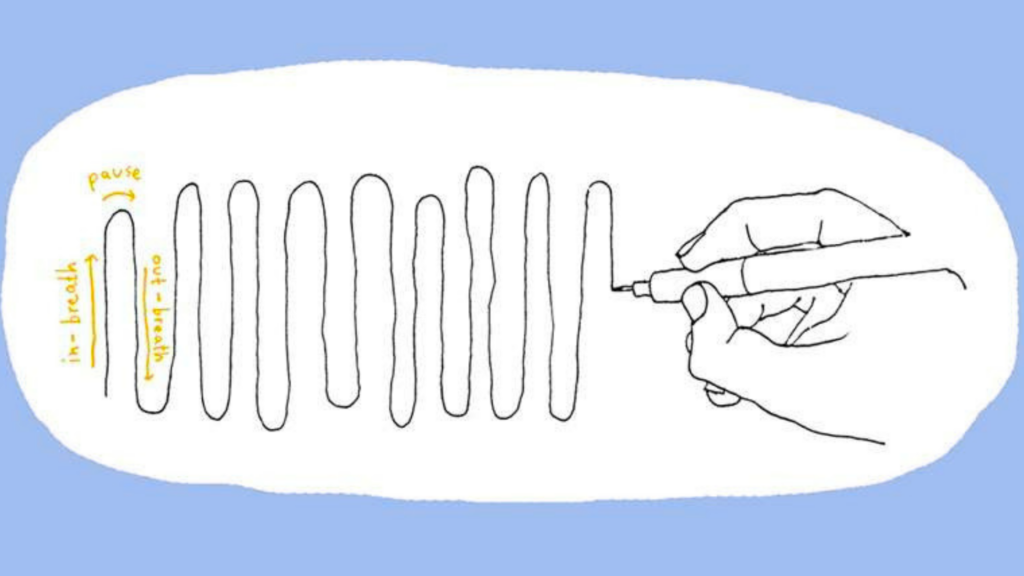
Continue to do this for three minutes. Chances are these will be some of the longest minutes of your life, but stick with it.
Okay, but why?
Once done, open your eyes and have a look with curiosity.
How did the lines change as you continued the exercise? Look at how long the inhales and exhales were based on the length of the lines. Did they change through the 3 minutes? One of the typical physical reactions to a stressful situation is a shortened breath. Did the lines get longer as you proceeded? Were you able to document your breath accurately or you did you automatically deepen it as you brought your attention to it?
Watch how the strength of your lines changed. Another typical reaction to stress is muscle tension. This is what makes you play around with your pen through an intense meeting or do a drum solo with your feet under the table. When you draw, you give your muscles something to do that helps to ease that intensity. That’s one of the ways movement supports stress reduction.
If you want to, do this exercise when you feel really relaxed, and see the difference. When we talk about self-discovery, most of us think about thought and mental processes, but knowing our reactions to stressful situations is also part of the picture (the pun was indeed intended). Now you know your breath a bit more, and maybe next time you are under pressure, you can consciously lengthen your exhales to remind your nervous system that you are safe and to gain access to some of your resources that are closed off during a stress reaction.
